
Phantom Thread, directed by Paul Thomas Anderson and released in 2017, delves deeply into the complexities of a romantic relationship between Reynolds Woodcock, a meticulous fashion designer, and Alma, his muse-turned-partner. At its core, the film explores opposites through character dynamics, visual symbolism, and thematic contrasts, often flipping traditional expectations to reveal a twisted balance in love and power.
Power vs. Submission
One of the film’s central explorations of opposites is the interplay between dominance and vulnerability. Reynolds begins as the controlling figure, imposing his rigid routines and emotional distance on Alma, who initially appears submissive and accommodating. However, as the story progresses, Alma subverts this by secretly poisoning him with mushrooms, rendering him weak and dependent, which allows her to assume a nurturing, dominant role. This reversal highlights a duality where strength and weakness alternate: Reynolds craves the relief of submission to escape his exhaustive control, while Alma finds empowerment in enforcing his vulnerability, leading to a mutual, albeit unhealthy, equilibrium where roles fluidly shift.
Cold vs. Warm Personalities and Visuals
The film uses color and lighting as a metaphor for opposing temperaments. Reynolds is associated with cold tones—blues, whites, and blacks—reflecting his emotional detachment and precision-driven life, influenced by his unresolved grief over his mother. In contrast, Alma embodies warmth through oranges and reds, symbolizing her disruptive, nurturing energy that fills the voids in his existence. As their relationship evolves, these palettes blend: post-marriage, characters adopt elements of each other’s colors, illustrating a merging of opposites in a give-and-take dynamic. Scenes of Alma’s dominance, like the poisoning sequences, are bathed in warm light, while Reynolds’ assertive moments revert to cooler hues, underscoring the ongoing duality without a clear resolution.
Masculine Control vs. Feminine Subversion
Phantom Thread also examines gender-based opposites, portraying Reynolds’ toxic masculinity—marked by arrogance, gaslighting, and a need for total control—as clashing with Alma’s subversive femininity. His domineering genius, shaped by maternal influences, seeks partners who either emulate or counter his mother, leading to a Freudian mother-son duality where Alma “mothers” him during induced illnesses. This flips abuser-victim roles, with Alma transforming from victim to enabler of a cycle where vulnerability becomes a form of strength, critiquing patriarchal power structures without fully resolving them.
Health vs. Illness as a Balancing Force
Opposites manifest in physical states, where Reynolds’ workaholic “health” (precision and productivity) contrasts with the deliberate illness Alma induces to force intimacy and care. This extreme measure, evoking Munchausen syndrome by proxy, allows Reynolds to relinquish control and be nurtured, turning weakness into a paradoxical path to relational balance. The film suggests that for such polarized personalities, harmony arises from embracing these contrasts, though it raises questions about the healthiness of such dependencies.
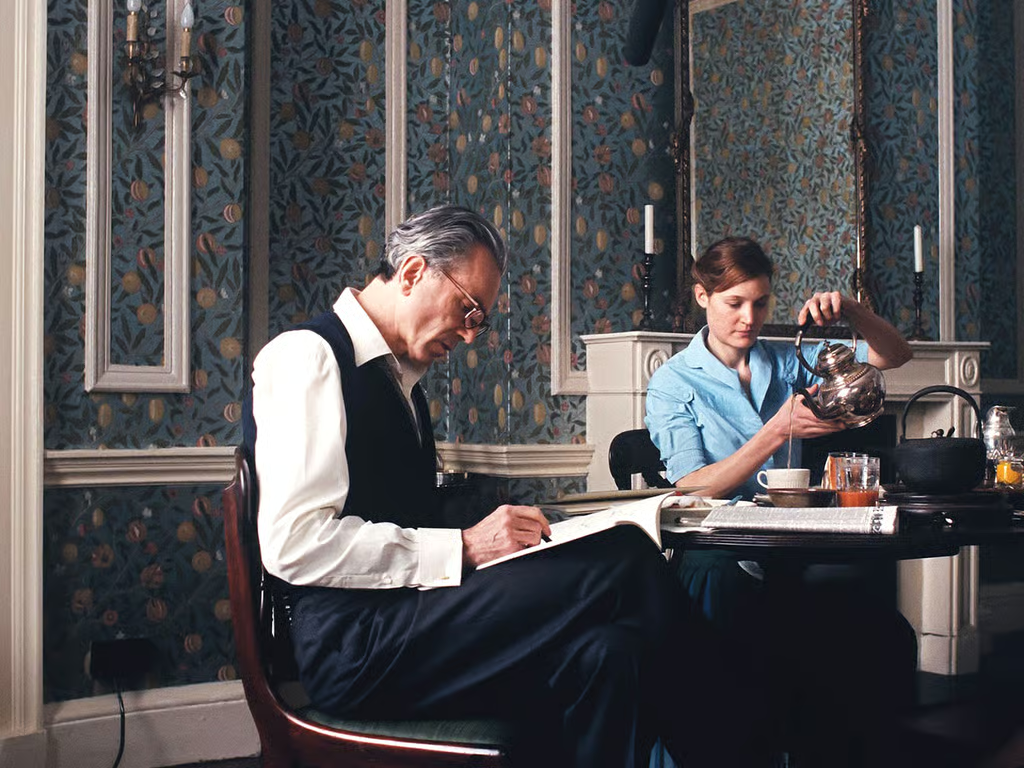
Overall, these explorations of opposites paint a portrait of love as a negotiated battleground, where duality—rather than harmony—defines enduring connection, blending romance with dark comedy and psychological depth.


