
As of late October 2025, the AI investment landscape has exploded into a multi-hundred-billion-dollar frenzy, driven by generative AI breakthroughs and infrastructure demands. Global private AI investment hit a record $109.08 billion in 2024 (the latest full-year data), with the U.S. capturing 76% of funding, but 2025 projections show continued acceleration amid geopolitical tensions and energy needs. While mega-rounds dominate—think OpenAI’s $40 billion valuation boost—startups face a double-edged sword: unprecedented capital access for proven players, but heightened scrutiny on profitability in a maturing market. Below, I’ll dissect key 2025 deals, regional trends, and their ripple effects on tech startups, drawing from reports like Stanford’s AI Index and CB Insights.
Major Global AI Deals in 2025: The Billion-Dollar Club
This year has seen a surge in megadeals (over $1 billion), with Q3 alone featuring 10 such rounds globally, up from prior quarters. These aren’t just cash infusions; they’re strategic plays tying AI to energy, cloud, and hardware. Here’s a table of standout deals through Q3 2025:
| Company | Funding Amount | Lead Investors/Key Partners | Focus Area | Implications |
|---|---|---|---|---|
| OpenAI | $40B (valuation round) | AMD, Nvidia, Broadcom, Microsoft | Generative AI models | Cements OpenAI’s lead in reasoning models; boosts U.S. dominance but raises antitrust flags. |
| Anthropic | $13B | Amazon (up to $4B extension) | AI safety and cloud integration | Fuels AWS’s AI push; highlights Big Tech’s role in startup scaling. |
| Mistral AI | €1.7B (~$1.85B) | European consortium | Open-source models | Bolsters EU’s AI sovereignty; counters U.S. giants with localized tech. |
| Scale AI | $14.3B | Andreessen Horowitz, Sequoia | Data labeling for AI | Record Q2 deal; underscores infrastructure’s value for training LLMs. |
| Caris Life Sciences | $6B (IPO) | Public markets | AI in healthcare diagnostics | Largest AI IPO; signals maturing exits for applied AI startups. |
| Microsoft (Three Mile Island) | $1.6B | Constellation Energy | Nuclear power for AI data centers | Not a startup deal, but enables AI growth; ties investments to sustainability. |
These deals total over $77B, with applied AI seeing $17.4B in Q3 alone—a 47% YoY jump. Generative AI specifically drew $33.9B globally, up 18.7% from 2023, per Stanford. M&A is booming too: AI targets saw a 127% value increase in H1 2025 vs. H1 2024, despite 20% fewer deals, as buyers pay premiums for talent and tech.

Economy | The 2025 AI Index Report | Stanford HAI
Global Breakdown: U.S. Leads, But Others Accelerate
The U.S. dominates with 76% of 2024’s $100.4B in private AI funding (Q4’24 alone: $43.8B), fueled by Bay Area hubs capturing 70% of domestic dollars. Europe follows at $19.42B (2024), with the EU’s €200B InvestAI plan launching in February 2025 to build “AI gigafactories.” China lags at $9.29B amid a broader Asia funding slide (H1 2025: $5.1B down), but leads in robotaxis and patents. Emerging players like India (compute growth) and Gulf states (investment hubs) are rising, per GM Insights.
AI startups represent 18% of funded companies but snag 34% of VC ($89.4B in 2025 so far), per Second Talent. In H1 2025, AI claimed 53-58% of global VC, double H1 2024’s share.
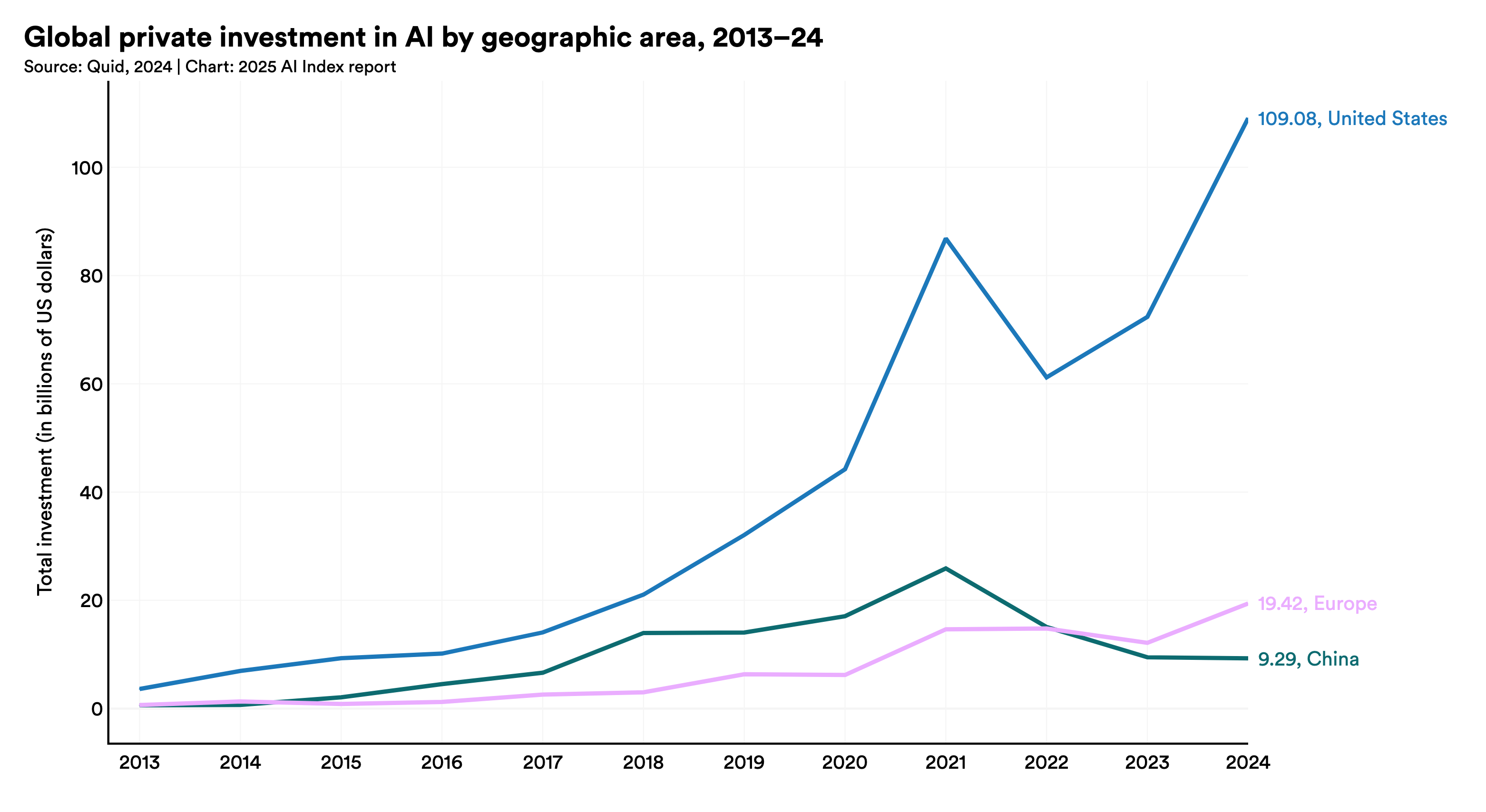
Economy | The 2025 AI Index Report | Stanford HAI
What This Means for Tech Startups
For tech startups, 2025’s deals signal opportunity amid caution. AI funding drives overall venture (Q2: $91B global, +11% YoY), but it’s concentrated: Mega-rounds make up 69% of funding, squeezing early-stage plays. Startups in infrastructure (e.g., data centers) or applied AI (healthcare, cybersecurity) thrive—Q2 cybersecurity AI: $4.9B up. But oversaturation risks a “bubble correction,” with VCs now demanding sustainable models over hype.
Positives:
- Exits Ramp Up: IPOs like Caris and Omada ($1.1B) signal a rebound; 2025 M&A expected strong with relaxed regs.
- Big Tech Partnerships: Deals like Amazon-Anthropic open doors for startups to integrate with clouds, accelerating go-to-market.
- Niche Wins: Small language models (SLMs) and agentic AI per Deloitte; startups can pivot to efficiency over scale.
Challenges:
- Talent and Compute Crunch: Big investments widen gaps; startups without deep pockets struggle with $15.7T projected AI revenue by decade’s end.
- Regulatory Risks: Geopolitical shifts (e.g., EU’s focus) could fragment markets, hurting global scalability.
- Funding Discipline: VCs like Andreessen Horowitz (47 deals, $3.2B) favor fundamentals; early-stage down as capital concentrates.
Looking Ahead: 2025-2026 Trends
PwC predicts compounding advancements in accuracy and automation, with AI adding $15T+ to revenue by 2030. McKinsey highlights robotics and responsible AI; startups should target these for funding. Expect more energy-tied deals (e.g., nuclear) and a shift to profitability—bubbles may burst, but core AI thesis holds. For startups, strategies include niche focus, Big Tech alliances, and proving ROI, per Dealmaker Tech.

The 2025 AI Index Report | Stanford HAI
In essence, 2025’s deals propel AI forward, but startups must navigate concentration and scrutiny to thrive—it’s not just about innovation, but viable business in a high-stakes game.


